
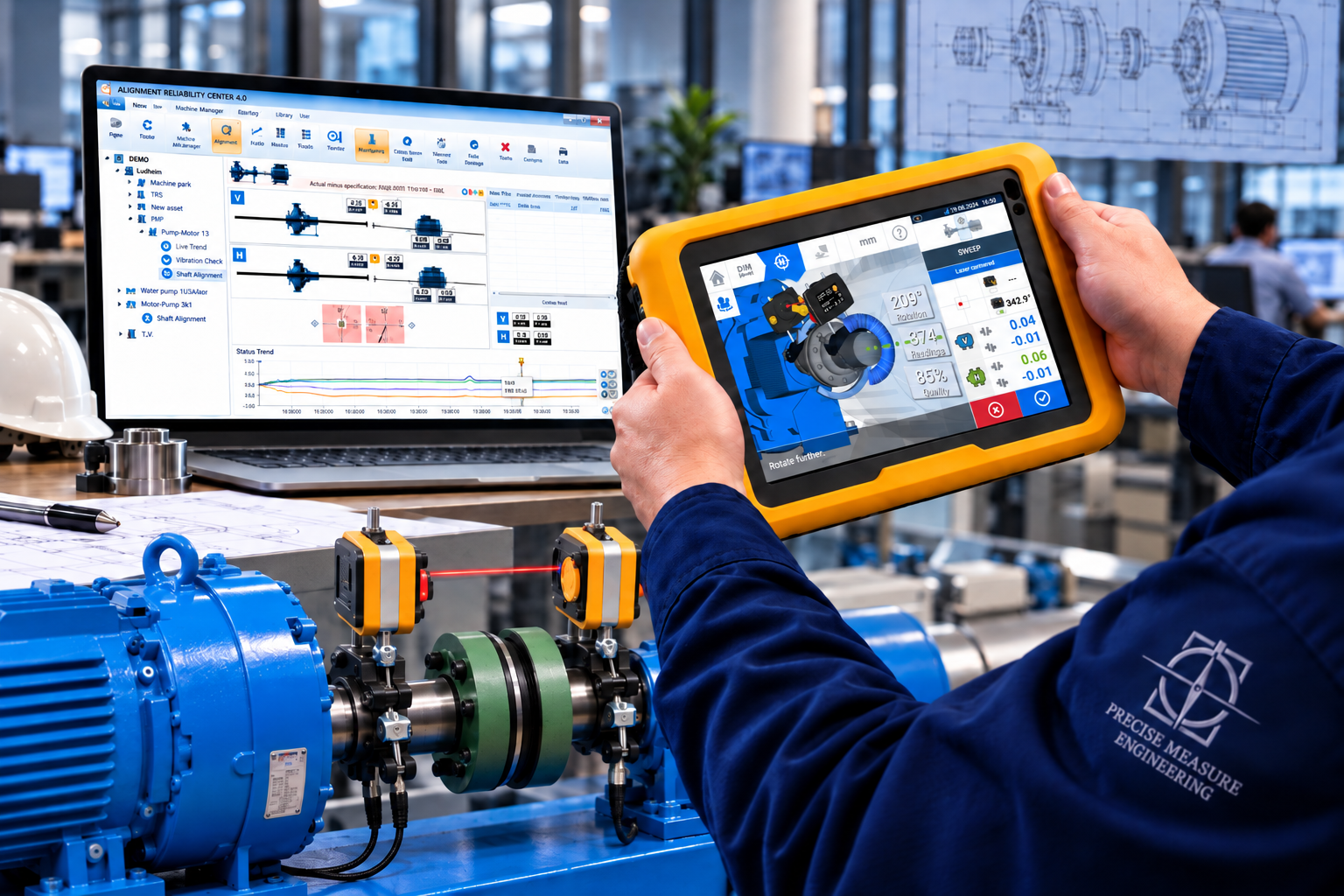
Field Balancing Analyser for Industrial Machinery
Every unplanned shutdown costs far more than the physical repair itself: lost production, team overtime, rushed spare parts, and missed delivery deadlines. Unresolved rotor imbalance is one of the most common causes of industrial machine failure and also one of the most preventable.
Dismantling large industrial assets to send them to an off-site balancing shop is costly, logistically complex, and time-consuming. At Precise Measure Engineering, we supply state-of-the-art field balancing equipment and high-performance portable field balancing analyser solutions across Singapore. With local inventory, calibration services, hands-on training, and engineering assistance, we help your maintenance teams restore smooth machine operation quickly and safely on-site.
What Is a Field Balancing Analyser?
A Field Balancing Analyser is a specialised diagnostic instrument used to measure, analyse, and correct mass imbalances in rotating components directly within their operational environment without removing the rotor from the machine.
By combining precision vibration acceleration/velocity sensors with optical or laser tachometers, a field balancing analyser measures two critical parameters:
- Amplitude: Indicates the severity of the unbalance forces.
- Phase Angle: Pinpoints the exact radial position of the heavy spot relative to a reference mark.
Using these dynamic readings, the analyser calculates the exact weight corrections required and their precise angular placement, bringing machine vibration levels back within acceptable ISO 21940 balance quality standards.
Why Singapore Industrial Plants Choose In-Situ Field Balancing
Operating industrial equipment in Singapore presents unique environmental and operational challenges that make rotor imbalance a recurring issue rather than a rare fault:
- High Ambient Humidity & Heat: Tropical weather accelerates corrosion, rust, and organic fouling on cooling tower fans, exhaust blowers, and pumps, leading to uneven mass distribution over time.
- Space-Constrained Facilities: Rooftop HVAC air-handling units, plant rooms in high-rise commercial towers, and dense process skids on Jurong Island make rigging, crane rental, and rotor removal extremely difficult and expensive.
- 24/7 Continuous Operations: Wafer fabs, data centres, hospitals, and petrochemical refineries cannot afford extended downtime. Correcting imbalance in place within hours keeps critical assets online.
Modern facilities increasingly rely on proactive strategies. Integrating wireless condition monitoring and industrial remote monitoring allows engineering teams to track vibration trends continuously and detect early signs of imbalance before they develop into serious mechanical problems.
Single-Plane vs. Two-Plane (Dynamic) Balancing
The choice between single-plane and two-plane balancing depends on the geometry, operational speed, and design of the rotor:
Key Features & Benefits
Our dynamic balancing analyser range is engineered for accuracy, speed, and durability in demanding industrial environments:
- Real-Time Phase & Amplitude Tracking: High-speed digital signal processing measures phase angles with extreme precision, eliminating guesswork when locating weight positions.
- Built-In Correction Calculator: Automatically determines exact correction masses and split-weight angular locations based on trial weight runs.
- Multi-Channel Capability: Simultaneously collect vibration and phase data from multiple bearing housings for faster diagnostic cycles.
- Automated Audit-Ready Reporting: Generates comprehensive "before and after" balance reports to confirm compliance with ISO limits and validate client handovers.
- Rugged & Portable Construction: IP-rated, heavy-duty housing designed to withstand humid outdoor plant conditions, oily marine environments, and tight plant rooms.
Furthermore, pairing field tools with continuous diagnostic platforms such as Remote machine monitoring and Remote equipment monitoring ensures that assets flagged during routine checks are kept under close surveillance post-correction.
Selecting the Right Equipment: Brands & Specifications
We supply portable field balancing tools from established global manufacturers, maintained with local inventory in Singapore for immediate delivery.
When evaluating a Field Balancing Analyser for your facility, consider factors such as channel expansion options, sensor compatibility (accelerometers/proximity probes), built-in ISO balance grades, battery run-time, and reporting export formats.
Applications Across Singapore Industries
In-situ field balancing is widely adopted across capital-intensive sectors throughout Singapore
Building Services & Commercial HVAC
Air-handling unit (AHU) fans, exhaust blowers, and cooling tower fans in commercial towers, shopping malls, hospitals, and mission-critical data centres.
Oil, Gas & Petrochemical
High-pressure centrifugal pumps, gas compressors, boiler feed pumps, and industrial agitators across facilities on Jurong Island.
Marine & Offshore Engineering
Shipboard ventilation fans, cargo pumps, and auxiliary rotating machinery at shipyards in Tuas and Loyang.
Semiconductor & Biomedical
Scrubber blowers, process pumps, and cleanroom exhaust units in wafer fabs and pharmaceutical plants.
Power Generation & Utilities
Heavy steam and gas turbine generators, induced draft (ID) fans, and water treatment pumps.
Manufacturing & Paper/Packaging
High-speed rollers, centrifuges, industrial mixers, and shredder drums.
How Field Balancing Works: Step-by-Step
Performing in-situ dynamic balancing follows a clear, structured methodology using a portable analyser:
- Initial Vibration Survey: Measure baseline vibration levels across all bearing positions to confirm that 1X RPM is the predominant frequency (the classic signature of mass unbalance).
- First Run (As-Found): Set up a photocell or laser tachometer with reflective tape on the shaft to measure running speed and establish a phase reference while recording baseline amplitude and phase.
- Trial Weight Run: Stop the machine, attach a known trial weight at a recorded angular position on the correction plane, and run the machine again to record the response vector change.
- Calculation & Weight Placement: The analyser's internal vector algorithm calculates the exact correction mass and angular position needed to counteract the original unbalance.
- Verification Run: Remove the trial weight, install the calculated permanent correction weight (via bolting, welding, or clip weights), and run the machine to verify that vibration levels fall safely within ISO limits.
Field Balancing vs. Traditional Workshop Balancing
Calibration, Service & Local Support in Singapore
An industrial diagnostic instrument is only as reliable as the support network standing behind it. Precise Measure Engineering provides comprehensive local backing across Singapore:
- Rapid On-Site Engineering Response: Singapore-based technical specialists available quickly to assist with complex rotor diagnostics without overseas time-zone delays.
- Traceable Equipment Calibration: Regular local sensor, accelerometer, and tachometer calibration services ensure audit-ready maintenance records and reliable measurements.
- Local Repair & Maintenance: Hardware diagnostics and component repairs are handled locally in Singapore to minimise instrument downtime.
- Readily Available Spare Parts: Magnetic mounts, triaxial accelerometers, extension cables, and laser tachometer kits are kept in local stock.
- Warranty & Hands-On Training: Includes manufacturer warranty coverage handled directly through our Singapore office, alongside practical on-site training for your maintenance staff covering setup, trial runs, and report generation.
Why Choose Precise Measure Engineering for Field Balancing Analysers for Industrial Machinery in Singapore?
Precise Measure Engineering provides trusted field balancing analysers and portable vibration equipment tailored for Singapore's industrial sector. By combining advanced diagnostic hardware, certified local engineers, and dedicated support, they empower maintenance teams to quickly detect rotor imbalances, minimise unplanned downtime, and optimize overall rotating equipment reliability.
15+ Years of Experience
Precise Measure Engineering delivers 15+ years of expertise in vibration analysis, diagnostics, balancing, and machinery reliability.
Local Singapore Support
Receive rapid technical assistance, on-site troubleshooting, and dedicated engineering support directly from a Singapore-based team.
Certified Technical Expertise
Work directly with ISO CAT I–IV certified specialists trained in advanced rotating machinery maintenance.
Hands-On Training & Guidance
Equip your internal maintenance personnel with practical skills through tailored, hands-on training programs.
Stop Rotor Vibration Before It Leads to Costly Breakdowns!
Improve machinery performance with reliable field balancing analysers in Singapore from Precise Measure Engineering. Get expert guidance, local technical support and a free on-site demonstration to find the right solution for your equipment.
Frequently Asked Questions (FAQs)
-
Precise Measure Engineering supplies high-performance field balancing analysers from leading global manufacturers, backed by local inventory, calibration, technical training, and after-sales support in Singapore.
-
Yes. Our application engineers can bring our equipment to your site anywhere in Singapore to conduct an operational demonstration on your own rotating machinery.
-
Single-plane balancing is ideal for narrow disc-like components (such as overhung fans and pulleys). Two-plane balancing is required for longer or flexible rotors (such as multi-stage pump shafts and motor armatures) where axial dynamic couple forces exist.
-
No. While baseline vibration and phase measurements are recorded while the machine is running, the asset must be safely stopped, locked out, and tagged out to install or weld correction weights onto the rotor.
-
High ambient heat and humidity accelerate atmospheric corrosion, scale buildup, and dust accumulation on fan blades and impellers. Over time, uneven material accumulation shifts the rotor's centre of gravity, causing vibration.