
Standing next to a massive turbine, high-capacity pump, or giant compressor, everything may appear rock solid to the naked eye. The hum seems steady, panel lights are green, and production is running flat out. However, beneath that smooth exterior, tiny high-frequency tremors ripple through shafts, bearings, and gears. Left unchecked, those gentle shakes can snowball into catastrophic mechanical failure, shutting down your plant and costing thousands of pounds in lost production every single minute.
That is why plant managers, reliability engineers, and maintenance teams rely on vibration analysis as their ultimate early warning system. By listening closely to machine motion, technical teams catch minor defects months before a breakdown occurs, saving valuable time, budget, and operational stress.
What Is Vibration Analysis?
Vibration analysis is a core non-destructive testing method used to measure and evaluate the oscillation patterns of industrial rotating equipment. Every machine in motion generates a unique baseline movement profile. By attaching specialized sensors to bearing housings and structural components, reliability specialists record these movement signals and analyze their frequency, amplitude, and pattern.
Unlike traditional reactive maintenance that waits for parts to fail, vibration analysis gives maintenance teams a clear window into internal asset health without disturbing daily operations.
How Vibration Signals Reveal Machinery Faults
When internal machine parts begin to wear out, loose fittings develop, or shafts bend, the baseline movement pattern changes pitch and intensity. Think of vibration analysis as a specialized medical stethoscope for heavy machinery.
Sensors capture kinetic energy and convert physical motion into electrical signals. Every mechanical defect—whether it is a pitted bearing race, bent shaft, or gear tooth wear—leaves a distinct signal fingerprint. By tracking these frequency shifts over time, maintenance teams stop guessing when a part might fail and start scheduling maintenance precisely when it makes sense for the production calendar.
Types of Vibration Analysis Techniques
Modern condition monitoring relies on several specialized analytical techniques to interpret machine health accurately:
Time Domain Analysis: Examines raw wave signals over time to spot sudden shocks, impacts, and peak energy spikes.
Frequency Domain Analysis (FFT): Converts complex wave signals into individual frequency spikes, pinning specific operational speeds to exact mechanical components.
Phase Analysis: Measures the relative timing of movement between different points on a machine to distinguish between shaft unbalance, looseness, and structural resonance.
Envelope Analysis (PeakVue): Filters out low-frequency background noise to highlight high-frequency impact spikes caused by early-stage bearing flaws or gear tooth pitting.
Common Causes of Abnormal Machine Vibration
Abnormal mechanical motion stems from several common mechanical and structural issues within rotating machinery:
Mass Unbalance: Uneven weight distribution on rotating impellers, fans, or rotors that generates severe centrifugal force.
Shaft Misalignment: Angular or parallel offset between driving and driven shafts, causing excessive radial and axial loads.
Bearing Wear: Pitting, spalling, or lubrication failure on internal rolling elements and race tracks.
Mechanical Looseness: Loose foundation bolts, cracked baseplates, or worn internal bearing fits that amplify standard operational movement.
Gear Mesh Defects: Worn, chipped, or misaligned gear teeth creating harmonic vibration spikes.
Industrial Applications of Vibration Analysis
Condition monitoring applies across virtually all sectors operating heavy rotating equipment:
Manufacturing & Process Plants: Protecting motor-pump assemblies, mixers, and conveyor drives.
Power Generation: Monitoring high-speed steam turbines, gas expanders, and massive generators.
Water & Wastewater Treatment: Maintaining continuous operation for heavy-duty submersible and centrifugal pumps.
Marine & Offshore Facilities: Safeguarding propulsion shafts, thrusters, and onboard auxiliary blowers.
Paper, Film & Converting: Ensuring precision alignment across multi-roll machinery setups using specialized diagnostic tools.
Essential Vibration Parameters: Displacement, Velocity and Acceleration
Accurate vibration analysis relies on measuring three key physical parameters, each tailored to specific frequency ranges and machine fault types:
1. Vibration Parameters
DISPLACEMENT (Low Freq / < 10 Hz)
Measures total distance moved (mils or microns)
Identifies structural looseness and foundation movement
2. VELOCITY (Mid Freq / 10 Hz - 1 kHz)
Measures rate of movement change (mm/s or in/s)
Ideal for detecting shaft unbalance and misalignment
3. Acceleration (High Freq / > 1 kHz)
Measures rate of velocity change (g's)
Detects early bearing wear and gear mesh impacts
Vibration Analysis Equipment and Instruments
Carrying out reliable diagnostic checks requires specialized hardware and diagnostic software, including:
Accelerometers: Piezoelectric transducers attached magnetically or via mounting studs to capture high-precision motion data.
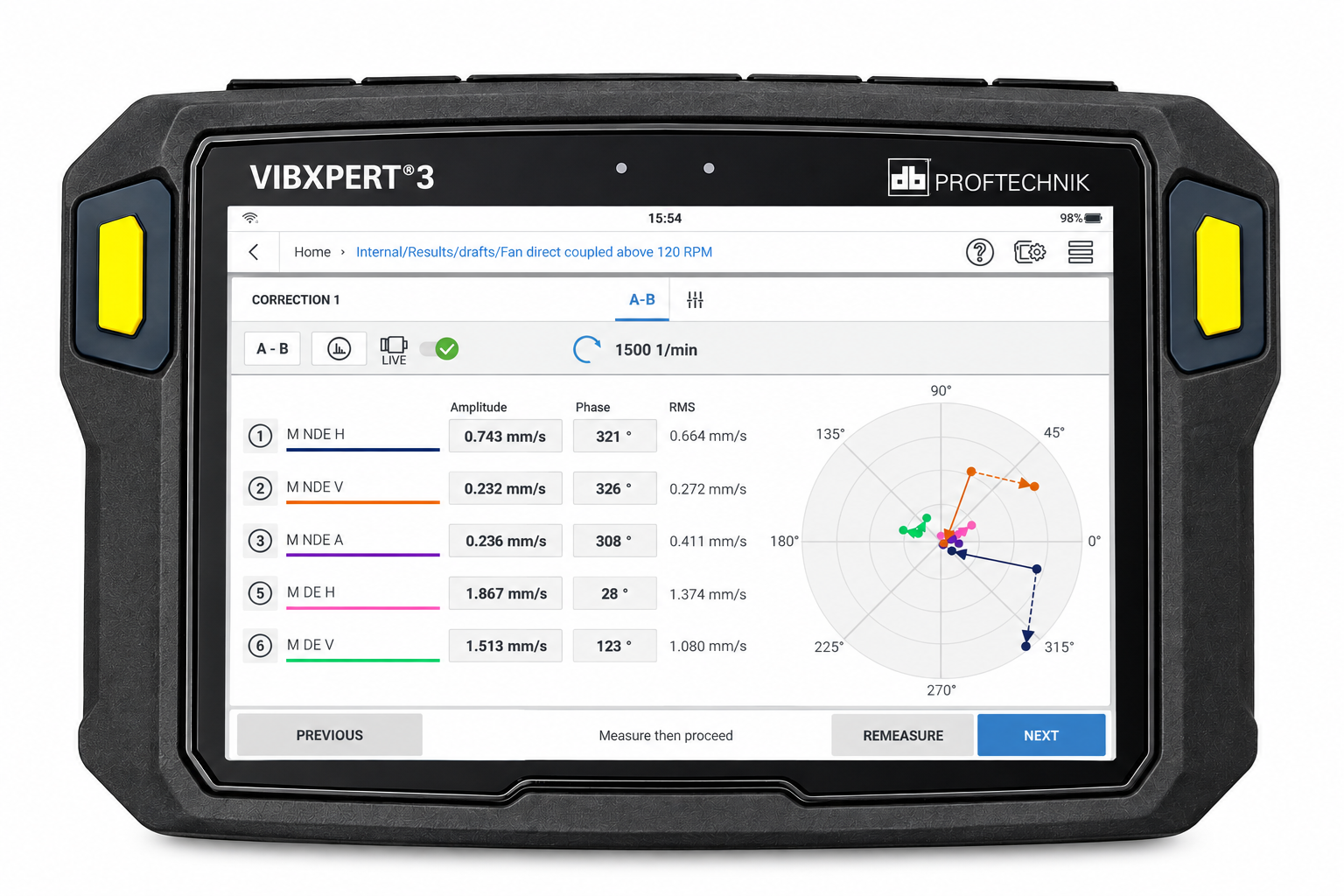
Portable Collectors & Analysers: Handheld diagnostic instruments used by technicians during regular route-based plant inspections.
Online Monitoring Systems: Permanently installed hardware suites providing 24/7 continuous data collection for high-criticality assets.
Laser Shaft Alignment Kits: Optical measurement systems used alongside vibration analysis to correct shaft offsets within sub-millimeter tolerances.
Understanding Vibration Frequency Spectrum and FFT
Raw diagnostic waves can look messy and complicated. Fast Fourier Transform (FFT) algorithms break down complex raw signals into clear frequency charts, separating overall motion into distinct spectral peaks:
By identifying where frequency spikes occur relative to the shaft's running speed (1X1\text{X}1X, 2X2\text{X}2X, 3X3\text{X}3X), engineers can isolate the root cause instantly.
Vibration Analysis for Predictive Maintenance
Integrating vibration analysis into a proactive maintenance framework delivers clear operational benefits:
Eliminates Unplanned Downtime: Early fault detection allows repairs during scheduled turnarounds rather than emergency mid-shift stops.
Extends Asset Lifespan: Reducing excessive motion protects expensive seals, bearings, and motor windings from secondary stress.
Reduces Repair Bills: Fixing an alignment issue or replacing a single bearing costs a fraction of rebuilding a completely destroyed pump casing.
Improves Workplace Safety: Preventing sudden mechanical breakage reduces flying debris and structural failure risks.
Optimises Energy Efficiency: Eliminating mechanical drag cuts power consumption across heavy electric motors.
Challenges in Industrial Vibration Measurement
Implementing a successful diagnostic program comes with a few practical hurdles:
Background Noise Interference: Nearby heavy machinery can send stray signals through floors and piping, muddying data.
Sensor Placement Errors: Mounting transducers on thin sheet covers rather than solid bearing housings leads to inaccurate readings.
Variable Operating Loads: Machines running under changing speeds and load conditions require specialized order tracking analysis.
Data Interpretation Skills: Interpreting complex spectral graphs requires experienced, certified diagnostic engineers.
Conclusion: Improving Equipment Reliability Through Vibration Analysis
Transitioning from reactive firefighting to structured predictive care is the most effective way to protect heavy capital assets. Partnering with experienced specialists like Precise Measure Engineering Pte. Ltd. ensures your plant receives accurate diagnostics, actionable recommendations, and expert support, from routine route monitoring to in-situ dynamic balancing and laser alignment.
Frequently Asked Questions About Vibration Analysis
-
Vibration analysis detects faults by recording machine motion using sensors, converting raw wave signals into frequency spectrums, and matching unique frequency spikes against known mechanical fault signatures.
-
Virtually all rotating industrial assets benefit from monitoring, including electric motors, centrifugal pumps, steam turbines, gearboxes, industrial fans, air compressors, and blowers.
-
The primary causes include rotor unbalance, shaft misalignment, rolling element bearing damage, mechanical looseness, gear mesh wear, and structural resonance.
-
Vibration monitoring tracks overall movement levels to flag changes over time, whereas vibration analysis breaks down the full signal spectrum to identify the root cause of the fault.
-
Critical, high-impact assets typically use continuous 24/7 online monitoring, while secondary or balance-of-plant machinery undergoes route-based checks monthly or quarterly.
